


Week 6 · June 16, 2025 · Mental Health
Burnout Is Not Just Tiredness — Understanding Chronic Stress
You're exhausted, but it's more than that. You feel detached from work you used to care about. Small tasks feel impossibly heavy. You can't remember the last time you felt genuinely rested, no matter how much you sleep. You're going through the motions.
This is what burnout actually feels like — and it's not the same as being tired.
What Is Burnout?
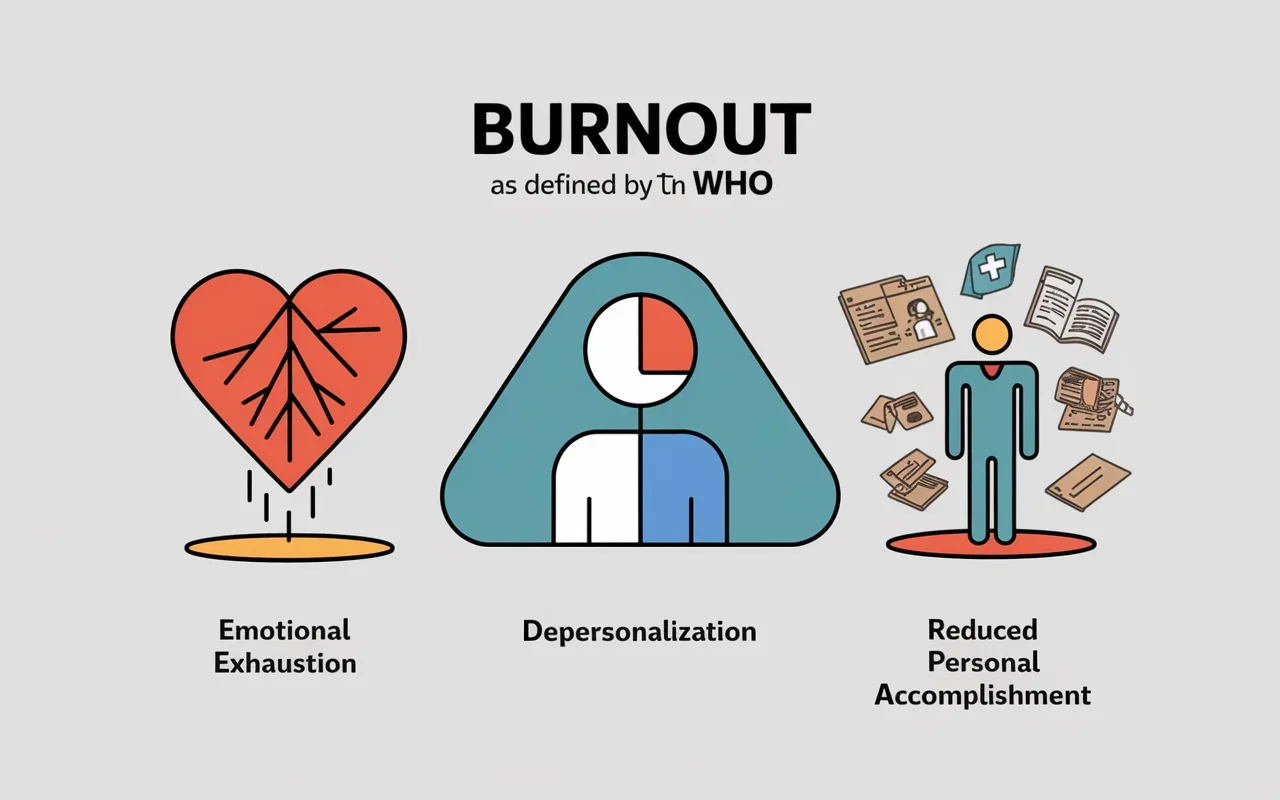
Burnout is a state of chronic stress that leads to physical and emotional exhaustion, cynicism and detachment, and a sense of ineffectiveness or lack of accomplishment. It was formally recognized by the World Health Organization as an occupational phenomenon, though it manifests in caregivers, parents, students, and people in high-stress life circumstances as readily as it does in the workplace.
Burnout doesn't happen overnight. It's the result of sustained, unresolved stress that gradually depletes your physical and emotional reserves.
Burnout vs. Regular Tiredness
Ordinary tiredness typically resolves with rest. A good night's sleep, a restful weekend, a vacation — and you come back feeling restored.
Burnout doesn't work that way. Rest provides only temporary and incomplete relief, and the underlying depletion remains. If you've taken time off and come back feeling just as empty as when you left, that distinction matters.
The Physical Side of Chronic Stress
Burnout is not just a mental health experience. Chronic stress has physical consequences that are well-documented in medical literature. These can include disrupted sleep, persistent fatigue, changes in appetite, gastrointestinal symptoms, increased susceptibility to illness, headaches, and a general sense of physical malaise.
The stress response system — which is helpful and appropriate in acute situations — becomes dysregulated under prolonged, unrelenting pressure. Understanding this helps explain why burnout isn't something you can simply willpower your way through.
Why Primary Care Is a Good Starting Point
If you're experiencing what sounds like burnout, a conversation with your primary care physician is a reasonable first step — and here's why.
First, some of the symptoms associated with burnout (fatigue, mood changes, difficulty concentrating, sleep disruption) can overlap with medical conditions worth evaluating. A physician can help sort out what's going on.
Second, your primary care doctor can help connect you with appropriate mental health support — whether that's counseling, behavioral health resources, or other interventions. They can also discuss the lifestyle factors that either worsen or buffer against chronic stress.
Third, having a physician who knows you and your history means you're not starting from scratch every time something changes.
You don't need to be in crisis to deserve support. If you've been running on empty for a while, that's worth a conversation.
─────────────────────────────────────────
Schedule a Free Meet & Greet
Ready to experience primary care that puts you first? Firebird Direct Primary Care offers transparent membership-based care with no insurance hassles, same-day appointments, and a physician who actually has time to listen. Schedule a free meet-and-greet at www.firebirddpc.com or call us at (614) 259-7987.
─────────────────────────────────────────────────────
DISCLAIMER
DISCLAIMER: The information provided in this blog post is intended for general educational and informational purposes only. It does not constitute medical advice, diagnosis, or treatment, and should not be used as a substitute for professional medical consultation, diagnosis, or treatment by a qualified, licensed physician or other healthcare provider. Always seek the advice of your doctor or another qualified health professional with any questions you may have regarding a medical condition or health concern. Never disregard professional medical advice or delay seeking it because of something you have read on this website. Firebird Direct Primary Care makes no representations or warranties of any kind, express or implied, about the completeness, accuracy, reliability, or suitability of the information contained in this blog post. Reliance on any information appearing on this site is solely at your own risk.



Why Your Insurance Card Doesn't Guarantee You a Doctor
Week 2 · May 19, 2025 · Insurance & Healthcare System
Why Your Insurance Card Doesn't Guarantee You a Doctor
You pay your monthly premiums. You carry your insurance card. You assume that when you need a doctor, you'll be able to see one.
That assumption is increasingly wrong — and understanding why matters for your health.
The Access Problem Is Real
There is a growing and well-documented primary care physician shortage in the United States. According to industry estimates, the country is projected to face a significant shortfall of primary care physicians in the coming years. But you don't need a statistic to feel this. You feel it when you call a new doctor's office and the next available appointment is three months away. You feel it when your longtime physician retires and you can't find anyone in-network to replace them. You feel it when you get a diagnosis that requires follow-up, and following up requires waiting.
Having insurance tells you how your care will be paid for. It says very little about whether care is actually available.
The Network Illusion
Most insurance plans advertise large provider networks, implying you have access to hundreds or thousands of doctors. What they don't tell you is how many of those doctors are actively accepting new patients, how long the average wait is for an appointment, or how far outside your immediate area you may need to travel to find one.
A network listing is a directory, not a guarantee of timely access.
Why Is There a Shortage?
The reasons are layered. Medical school and residency pipelines haven't kept pace with population growth and physician retirements. The administrative burden of insurance billing — which can consume a significant portion of a physician's workday — drives many doctors out of independent practice or into employed settings with larger patient panels. Burnout among primary care physicians is at an all-time high. And rural and underserved communities face the most acute shortages.
The result is a system where primary care physicians are being asked to see more and more patients with less and less time — and patients feel it on both ends.
What Can You Do?
Establish care before you need it. The worst time to look for a primary care physician is when you're already sick. Finding a doctor you trust and building that relationship while you're healthy gives you a foundation when things get complicated.
Understand your plan's actual network. Call the numbers listed. Confirm that physicians are accepting new patients before counting on them.
Consider alternatives to traditional primary care. Direct Primary Care practices often have more capacity and better access than traditional offices precisely because they limit their patient panels and don't rely on insurance reimbursement for every visit.
Your insurance card is a financial tool. Your relationship with a primary care physician is a health resource. They're not the same thing — and protecting both is worth your attention.
─────────────────────────────────────────────────────
Schedule a Free Meet & Greet
Ready to experience primary care that puts you first? Firebird Direct Primary Care offers transparent membership-based care with no insurance hassles, same-day appointments, and a physician who actually has time to listen. Schedule a free meet-and-greet at www.firebirddpc.com or call us at (614) 259-7987.
─────────────────────────────────────────────────────
DISCLAIMER
DISCLAIMER: The information provided in this blog post is intended for general educational and informational purposes only. It does not constitute medical advice, diagnosis, or treatment, and should not be used as a substitute for professional medical consultation, diagnosis, or treatment by a qualified, licensed physician or other healthcare provider. Always seek the advice of your doctor or another qualified health professional with any questions you may have regarding a medical condition or health concern. Never disregard professional medical advice or delay seeking it because of something you have read on this website. Firebird Direct Primary Care makes no representations or warranties of any kind, express or implied, about the completeness, accuracy, reliability, or suitability of the information contained in this blog post. Reliance on any information appearing on this site is solely at your own risk.

Week 2 · May 19, 2025 · Insurance & Healthcare System
Why Your Insurance Card Doesn't Guarantee You a Doctor
You pay your monthly premiums. You carry your insurance card. You assume that when you need a doctor, you'll be able to see one.
That assumption is increasingly wrong — and understanding why matters for your health.
The Access Problem Is Real
There is a growing and well-documented primary care physician shortage in the United States. According to industry estimates, the country is projected to face a significant shortfall of primary care physicians in the coming years. But you don't need a statistic to feel this. You feel it when you call a new doctor's office and the next available appointment is three months away. You feel it when your longtime physician retires and you can't find anyone in-network to replace them. You feel it when you get a diagnosis that requires follow-up, and following up requires waiting.
Having insurance tells you how your care will be paid for. It says very little about whether care is actually available.
The Network Illusion
Most insurance plans advertise large provider networks, implying you have access to hundreds or thousands of doctors. What they don't tell you is how many of those doctors are actively accepting new patients, how long the average wait is for an appointment, or how far outside your immediate area you may need to travel to find one.
A network listing is a directory, not a guarantee of timely access.
Why Is There a Shortage?
The reasons are layered. Medical school and residency pipelines haven't kept pace with population growth and physician retirements. The administrative burden of insurance billing — which can consume a significant portion of a physician's workday — drives many doctors out of independent practice or into employed settings with larger patient panels. Burnout among primary care physicians is at an all-time high. And rural and underserved communities face the most acute shortages.
The result is a system where primary care physicians are being asked to see more and more patients with less and less time — and patients feel it on both ends.
What Can You Do?
Establish care before you need it. The worst time to look for a primary care physician is when you're already sick. Finding a doctor you trust and building that relationship while you're healthy gives you a foundation when things get complicated.
Understand your plan's actual network. Call the numbers listed. Confirm that physicians are accepting new patients before counting on them.
Consider alternatives to traditional primary care. Direct Primary Care practices often have more capacity and better access than traditional offices precisely because they limit their patient panels and don't rely on insurance reimbursement for every visit.
Your insurance card is a financial tool. Your relationship with a primary care physician is a health resource. They're not the same thing — and protecting both is worth your attention.
─────────────────────────────────────────────────────
Schedule a Free Meet & Greet
Ready to experience primary care that puts you first? Firebird Direct Primary Care offers transparent membership-based care with no insurance hassles, same-day appointments, and a physician who actually has time to listen. Schedule a free meet-and-greet at www.firebirddpc.com or call us at (614) 259-7987.
─────────────────────────────────────────────────────
DISCLAIMER
DISCLAIMER: The information provided in this blog post is intended for general educational and informational purposes only. It does not constitute medical advice, diagnosis, or treatment, and should not be used as a substitute for professional medical consultation, diagnosis, or treatment by a qualified, licensed physician or other healthcare provider. Always seek the advice of your doctor or another qualified health professional with any questions you may have regarding a medical condition or health concern. Never disregard professional medical advice or delay seeking it because of something you have read on this website. Firebird Direct Primary Care makes no representations or warranties of any kind, express or implied, about the completeness, accuracy, reliability, or suitability of the information contained in this blog post. Reliance on any information appearing on this site is solely at your own risk.

What Is Direct Primary Care — and Why Is Everyone Talking About It?
So what exactly is Direct Primary Care?